
Weather or Not? The Pros and Cons of Weather Insurance.
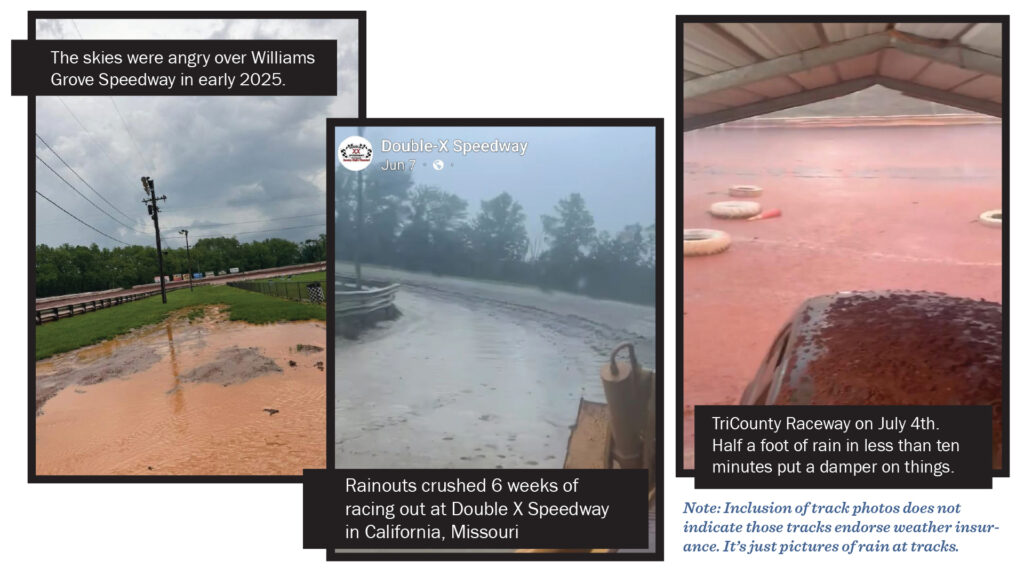
During the start of the 2025 racing season, a high percentage of races were cancelled or postponed due to weather. We thought it might be a good idea to check in on weather insurance so tracks and promoters could start working on a gameplan for 2026. Rain, in particular, poses a unique threat to dirt tracks, where even moderate precipitation can turn a race-ready surface into an unmanageable quagmire, endangering drivers and equipment while costing promoters tens of thousands in lost revenue. Traditional insurance often falls short, requiring lengthy claims processes and proof of exact financial losses. Enter parametric weather insurance, a data-driven solution gaining traction in the industry, with providers like Vortex Weather Insurance leading the charge.
What Is Parametric Weather Insurance?
Unlike traditional indemnity-based insurance, which reimburses for verified losses after a lengthy adjustment process, parametric insurance pays out based on predefined triggers using objective, independent data. For dirt track racing, the primary product is rain coverage. According to Vortex Weather Insurance, a policy might specify a rainfall threshold—say, 0.25 inches over a four-hour window during a race event. If NOAA weather stations or other third-party sources record precipitation meeting or exceeding this threshold, the policy’s full coverage limit is paid out automatically. No adjusters, no financial audits—just swift cash to offset losses.
Vortex emphasizes hyper-localized data, utilizing radar and other precise location data sources at the track rather than distant airports, reducing discrepancies between reported and actual conditions. Policies are customizable: promoters can choose coverage periods (e.g., a single race night or an entire season), set payout limits to match budgets, and define specific weather perils like rain or extreme temperatures. Pricing hinges on historical weather data—drier periods mean lower premiums, while wetter ones cost more. Vortex aims to keep premiums at 10% or less of the coverage limit, even for high-probability payout scenarios, making it accessible for small and mid-sized tracks.
Why Dirt Track Racing Needs Weather Insurance
Dirt track racing is uniquely vulnerable to weather. Unlike paved circuits, dirt surfaces absorb water, becoming slick or soupy, which can halt events for safety reasons. A single rainout can cost a promoter $50,000 or more in ticket sales, concessions, and sponsor commitments, with ripple effects on local economies—hotels, restaurants, and vendors all take a hit. In 2023, industry reports noted that 30% of scheduled dirt track events in the Midwest faced weather-related disruptions, with smaller venues hit hardest due to tight margins.
Traditional insurance often fails to address these losses. Indemnity policies require promoters to prove “actual loss sustained,” a process involving receipts, financial statements, and adjuster visits that can drag on for months. Payouts are often reduced if losses are deemed less severe than claimed, leaving promoters short. Parametric insurance sidesteps this by tying payouts to measurable weather events, not financial forensics. For example, a $100,000 policy might cost $8,000 for a July race in a region with a 20% historical chance of heavy rain, providing a predictable safety net.
Benefits for the Dirt Track Industry
The advantages of parametric weather insurance are clear, especially for an industry as weather-sensitive as dirt track racing:
Speed of Payouts: Claims are processed in days, not months, using verified weather data. This rapid liquidity helps promoters cover refunds, pay staff, or reschedule events without crippling cash flow. For instance, a track facing a rainout can receive a full payout within a week, keeping operations afloat.
Transparency and Simplicity: With payouts triggered by objective metrics, there’s no haggling over loss amounts. This eliminates disputes with insurers and reduces administrative burdens, a boon for small tracks with limited staff.
Customizability: Promoters can tailor policies to their needs—specific dates, hours, or weather thresholds—ensuring coverage aligns with their risk profile. A track in a dry region might opt for lower limits, while one in a rainy area might prioritize higher coverage.
Empowering Growth: By mitigating weather risks, promoters can confidently book bigger events, secure larger sponsors, or invest in improvements, knowing a rainout won’t spell financial ruin.
Vortex’s use of independent hyper-localized data further enhances reliability, addressing the industry’s need for precision in areas where weather can vary dramatically over short distances.
Challenges and Limitations
Despite its promise, parametric weather insurance has drawbacks that promoters must weigh:
Basis Risk: The biggest pitfall is the gap between policy triggers and actual conditions. If the track purchases a policy with a .50” threshold, and .45” of rainfall is recorded during the risk period, no payout occurs. This “basis risk” can leave promoters empty-handed despite real losses. Although there are alternative structuring options that can reduce this risk.
Premium Costs: While Vortex targets premiums at 10% or less of coverage, costs can climb in historically wet regions or seasons. For smaller tracks, even a $5,000 premium per event can strain budgets, especially if no payout is triggered.
Limited Scope: Parametric policies typically cover specific perils like rain. Other disruptions—high winds, extreme heat, or fog—require additional clauses, increasing complexity and cost.
Data Dependency: Payouts rely on third-party data accuracy. A malfunctioning weather station or localized anomaly could lead to disputes, though Vortex mitigates this with multiple data sources.
Industry chatter on platforms like X reflects mixed sentiment. Some promoters praise the quick payouts, with one noting, “Saved us $60,000 last season—worth every penny.” Others caution about non-triggered losses, with a post lamenting, “Paid $10,000 in premiums, got nothing when we canceled for mud but the gauge read dry.”
The Road Ahead
Parametric weather insurance is reshaping how dirt track promoters manage risk. By leveraging data from NOAA and other sources, companies like Vortex offer a lifeline in an industry where weather can make or break a season. The ability to secure fast, predictable payouts empowers tracks to plan with confidence, from small-town ovals to regional circuits. However, promoters must carefully assess their local weather patterns and financial thresholds to ensure policies align with their risks.
As climate patterns grow more erratic—2024 saw a 15% increase in unpredictable rainfall across the U.S., per NOAA—parametric insurance’s role will likely expand. Tracks adopting it report scheduling more ambitious events, knowing they’re insulated from nature’s whims. Yet, success hinges on understanding the trade-offs: the certainty of data-driven payouts versus the risk of uncovered losses. For an industry built on speed and grit, weather insurance offers a way to keep the engines roaring, rain or shine.
